
Can I Go to Urgent Care for Kidney Pain?

Yes. Urgent care can evaluate some mild, stable cases of kidney or flank pain, including symptoms that may come from a urinary tract infection or kidney stone. A provider can review your symptoms, examine you, and recommend urine tests or further evaluation. Patients with suspected stones can also receive an initial assessment through our kidney stone evaluation services in Clear Lake. However, severe pain, fever with flank pain, repeated vomiting, or difficulty passing urine requires urgent medical assessment and may require emergency care.
Kidney pain is not always caused by the kidneys. This guide explains possible causes, what urgent care can check, and how to recognize symptoms that need hospital treatment.
Understanding Kidney Pain
Kidney related pain is often felt in the back or side, below the ribs, and may spread toward the abdomen or groin. It can feel like a steady ache or sharp pain that comes in waves. Muscle strains can cause pain in a similar area, so the location alone cannot confirm a kidney problem. Urinary changes, fever, nausea, and other symptoms help guide the evaluation.
Common Causes of Kidney Pain
Kidney Stones
Kidney stones are hard deposits of minerals that may cause sharp pain in the side or back, sometimes spreading toward the groin. Pain can come in waves and may occur with nausea or blood in the urine. Our kidney stone services explain what testing and follow-up may be needed.
Kidney Infections (Pyelonephritis)
A kidney infection is usually caused by bacteria that have moved upward through the urinary tract. Common symptoms include flank pain, fever, chills, nausea, and frequent or painful urination. According to the National Institute of Diabetes and Digestive and Kidney Diseases, kidney infections need prompt medical attention because untreated infections can lead to serious complications, including sepsis.
Urinary Tract Infections (UTIs)
A bladder infection often causes burning urination, urgency, or frequent urination. Some infections can spread to the kidneys. If urinary discomfort is your main symptom, learn how our clinic evaluates urinary tract infections.
Hydronephrosis
Hydronephrosis occurs when urine backs up and causes swelling of the kidney, sometimes because of a blockage. Finding the cause may require ultrasound, CT imaging, or specialist assessment.
Polycystic Kidney Disease
This inherited condition causes fluid filled cysts to develop in the kidneys. Pain can occur, but diagnosis and ongoing care generally require a primary care clinician or kidney specialist.
Should You Go to Urgent Care for Kidney Pain?
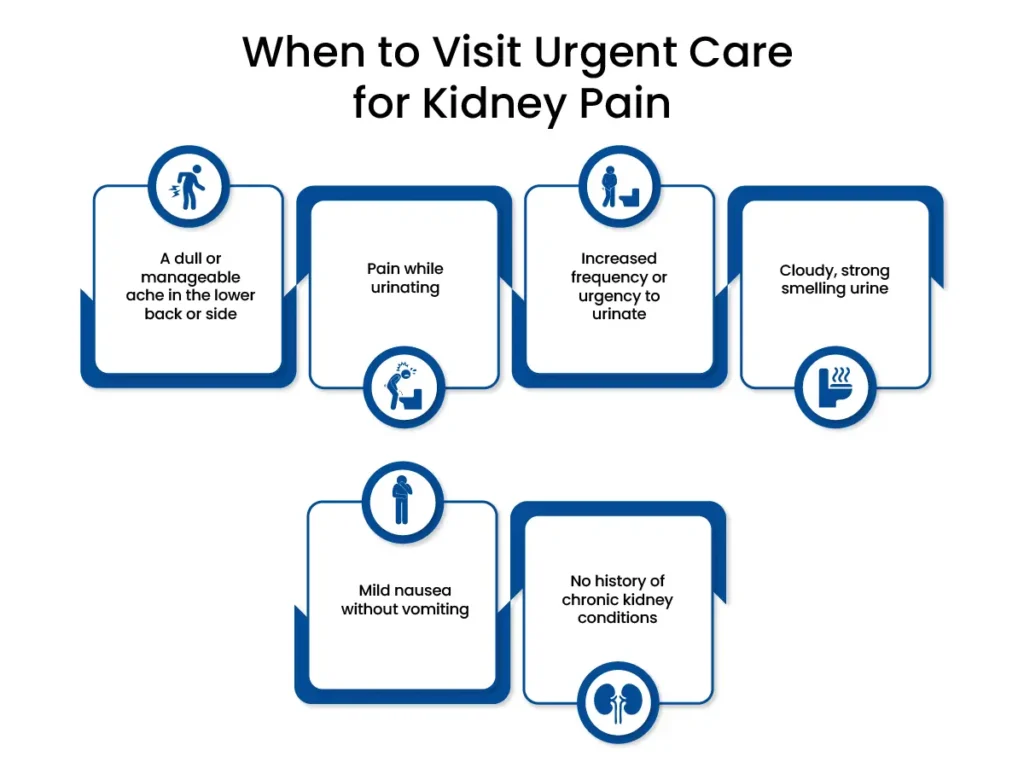
Urgent care may be appropriate when you have mild, manageable back or side pain, remain otherwise well, and have no emergency warning signs. Seek a timely medical evaluation if you notice:
- A dull or persistent ache in the back or side
- Burning or discomfort during urination
- Frequent or urgent urination
- Cloudy or unusually strong-smelling urine
- Mild nausea without repeated vomiting
Do not assume that mild pain rules out a significant problem. Contact a healthcare professional promptly for new flank pain, especially if you have a history of kidney disease, are pregnant, or have only one functioning kidney.
What Urgent Care Can Do for Kidney Pain?
Yes. An urgent care provider can review symptoms such as fever, flank pain, and urinary changes, then examine you and recommend appropriate testing. A urinalysis may identify findings that suggest infection, such as white blood cells or bacteria. A urine culture may be ordered to help identify the organism, although results usually take longer than a rapid urine test.
A urine test does not by itself show how severe an infection is or always prove that the kidneys are involved. Blood tests, imaging, or emergency evaluation may be needed. Priority Urgent Care offers selected in-house lab testing, but specific tests and turnaround times should be confirmed with the clinic.
If you suspect a kidney infection, seek medical attention promptly rather than trying to treat it with home remedies alone.
What Urgent Care Can Do for Kidney Pain
- Review your symptoms, medical history, and medications
- Check vital signs and examine your abdomen and back
- Perform or arrange urine testing when appropriate
- Recommend suitable pain relief or antibiotics when a bacterial infection is diagnosed
- Refer you for advanced imaging, emergency care, or urology assessment when needed
An urgent care visit cannot always confirm a kidney stone or identify a blockage. Ultrasound and CT scans may be needed elsewhere; routine X-rays cannot reliably rule out stones.
When to Go to the Emergency Room
Seek emergency care when kidney or flank pain is accompanied by any of these warning signs:
- Severe or uncontrolled pain, especially pain that comes in intense waves
- Fever or shaking chills with flank pain or a suspected kidney stone
- Inability to pass urine or suspected urinary blockage
- Repeated vomiting or inability to keep fluids down
- Confusion, fainting, extreme weakness, or other signs of serious illness
- Heavy bleeding or blood in urine with significant pain or inability to urinate
An infected, obstructed kidney can be a medical emergency. Call 911 for confusion, collapse, or other life-threatening symptoms. Visible blood in urine should also be evaluated promptly even if other warning signs are absent.
What to Expect During an Urgent Care Visit
Your provider will ask when the pain started, where it is located, whether it comes and goes, and whether you have urinary symptoms, fever, nausea, or prior kidney problems. The examination may include vital signs and checking for tenderness in the back or abdomen. Urine testing and additional testing are considered according to your symptoms.
Potential Treatments
- Appropriate antibiotics for diagnosed bacterial urinary infections
- Medication to manage pain or nausea when suitable
- Hydration advice based on your health and symptoms
- Referral to an emergency department or specialist if advanced imaging, intravenous treatment, or procedures may be needed
Antibiotics do not treat kidney stones, and fluid treatment does not replace evaluation for a blockage or infection. Your provider will explain the safest next step.
How to Lower Your Risk of Future Kidney Problems
- Stay adequately hydrated unless your clinician has advised fluid restrictions.
- Limit excess sodium, particularly if you have had kidney stones.
- Seek timely care for urinary symptoms rather than ignoring a possible infection.
- Follow up for recurrent stones, blood in your urine, or a history of kidney disease.
- Ask your clinician about personalized prevention if you have had stones before.
Prevention varies by the underlying problem. For example, kidney stone prevention recommendations may depend on the type of stone and your health history.
FAQs About Kidney Pain and Urgent Care
Visit Priority Urgent Care in Clear Lake, TX
Priority Urgent Care evaluates suitable non-emergency kidney and urinary symptoms at 2323 Clear Lake City Blvd, Suite 130, Houston, TX 77062. Our team can assess your symptoms, recommend available tests, and explain when advanced imaging or emergency care is necessary.
Call (346) 483-0112 or use online check-in before visiting. If you have emergency warning signs, go directly to an emergency department rather than delaying care.